
On the international scene, in the past, they have held a prominent position: on the routes to Spain and the United Kingdom and to the Americas; loved and cited by characters of Shakespeare's caliber; served on the nobility tables.
The wines of the Canary Islands are now ready for the conquest of their small space in the current global market.
The archipelago intends to claim itself as an oenological micro-power. We're talking about a production of a few million bottles.
From Fuerteventura, the first island to produce wine, to Lanzarote, the last in the order of time where the vine was planted after the great eruption of 1730 (lasted no less than 6 years), the wine heritage sees 33 varieties of grapes, and most of the labels come out under the names Gran Canaria and Lanzarote.
This conglomerate of havens is one of the places of wine where sustainable viticulture has been the only production opinion for centuries. Free zone not touched by the philosopher.
The wine sector, in recent times of its history, has been activated mainly for tourism consumption, but for some years the wineries have been targeting international test banks.
Many, for example, have been the samples sent to the 2013 edition of the mountain wine competition and the small Cervim islands.
The Canary Islands have shown themselves with wide backs, with Tenerife highlighting with oars and silver (to read the article click here). The sector is growing and is increasing in employment.
Bodegas, certification authorities and promoters are on the net to promote wine among the main tourist attractions as well as the marine, landscape and artistic treasures that the archipelago has owned, and they have been doing so for several years with great anticipation of other countries with a wine vocation.
In short, the wine canaries travel wind in the stern, not just for the benefit of the Alisios, who beat them day and night and all year round. True, precisely this incessant blow is one of the merits of the quality of the grapes that grow in this part of the Atlantic Ocean, but it is the unforeseeable and indomitable power of the earth and the adaptation of man that have turned these worlds into oenological lands of exception.
And to this we add a highly tourism-oriented mentality that has led the archipelago to be the destination of wine today among the most quoted in the world. Only in Lanzarote, which is not interested at all in mass tourism loving movement, the tourist influx every year is just over two million vacationists, with a movement of passengers at its airport of 5 million.
We are talking about an island with 42% of the territory made up of protected areas.
We imagine the Canary Islands and inevitably other islands are brought to mind where viticulture is a constant challenge against the elements: Pantelleria, the Eolias with Salina, Lipari and Vulcano and the Etna.
Conformity also emerges in the light of the inclusion in the list of sites protected by UNESCO.
Four of the seven ocean sisters are declared a UNESCO Biosphere Heritage: Tenerife, Lanzarote, Fuerteventura, La Palma, a title they share with the eolian archipelago, while the Etna volcano has been declared a World Heritage Site for a very short time.
The comparison with our home then jumps by assessing the modalities with which the world of wine at that equatorial latitude is developing: communication and marketing assumed as priority promotional practice and a capacity to improve the infrastructure far from us light years (for example the construction of a road there occurs in pre-established times, declared, respected in an open and close of eyes, with equipment that alternates day and night, in summary the administration puts in place a very efficient machine so that everything can guarantee the guest the maximum service).
But without wanting to point out always and only for the pleasure of complaining, the difference between your rhythm and our schedule can only jump into sight. True, from steps forward, in these areas of Sicily, they are taking place, but with greater reason, for the many parallels that remain, the Canary Islands are among the competitors to be looked at more carefully.
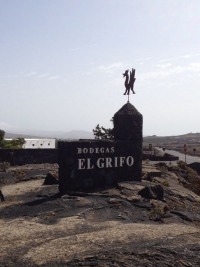
We come to the tasting that has motivated this brief approach to the archipelago. We have tasted the D.O. Malvasia of the winery El Grifo de San Bartolomé.
It is located in the Masdache Tinajo, the area, next to La Geria, where the largest number of wineries on the island is concentrated, 13 of the 17 registered with the Regulatory Council of Denomination of Origin Wines of Lanzarote.
Founded in 1775, it is the fifth oldest in Spain and the oldest in the Canary Islands. Today it produces 600 thousand litres a year and has 12 references. Sixty hectares are owned and the rest of the grapes are conferred by small winegrowers on the island.
The first to have directed production for the market, and not just for the island, with the introduction of bottling machines and steel for wine. It has the longest vines of Lanzarote, some dating back to 1750.
Keep an old-fashioned file, including 1881 bottles, and also assume one of the most corporeal libraries dedicated to wine with 5,000 volumes.
It exports to the United States and Germany but is targeting emerging markets, mainly China and Russia.
Considered the icon of Lanzarote wine, it must be recognized the merit of having lit the reflectors on the potential of the island.
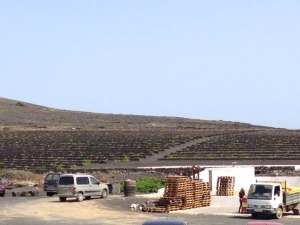
The growing system here is synonymous with challenge, tenacity and continuous sacrifice.
After the eruptions that destroyed Lanzarote for six years in a row, changing its shape and economic and social order, the peasants managed to remodel the landscape by making it back again productive this time with the vine (Lanzarote before that date was known as «The barn»).
The average yields per hectare, although difficult to believe, are 100 - 150 quintals with a density of 400 - 500 plants.
Lanzarote in total produces 20 thousand quintals of grapes and the average price recognized at one kilo of grapes is 1.5 euros.
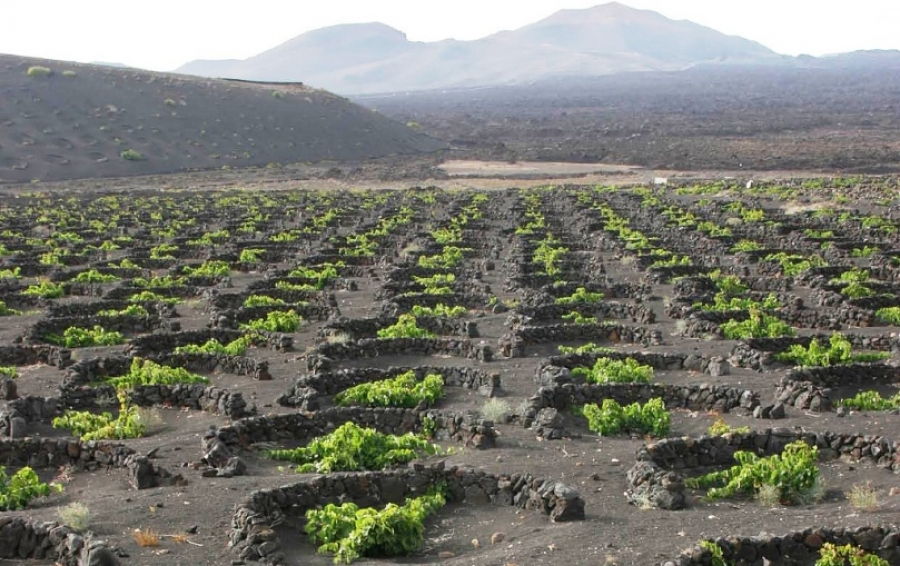
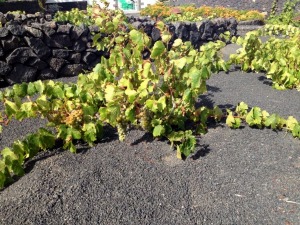
The vine is grown in deep-rooted (system spread in La Geria and by which it has been the only place in Spain candidate for the third edition of the Council of Europe's Biennial Landscape Prize) covered with volcanic ash that retains the moisture of the ground preventing its evaporation, nourishes the plant and protects it from disease attack.
But there are also other systems of cultivation and landscape architecture that protect the vines from the wind (in chaboco, in parral, in banks). A curiosity: formerly to cultivate these special vineyards camels were used.
In the 18th century over 5,000 inhabitants were counted in Lanzarote 1700 camels, in 1940 the number even rose to 3,000.
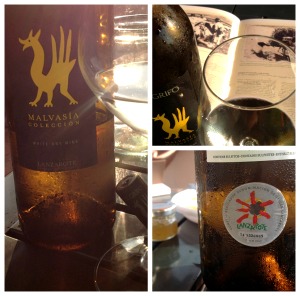
We have tasted the Malvasía Seco Collection D.O. Lanzarote 2012. The variety is the Volcanic Malvasia, the backbone of the enological identity of the archipelago, but that in Lanzarote has found its cradle.
It arrives there after the second half of the 19th century after a violent attack of hearing devastated the plantations of the other islands. The wine is presented in sight with bright yellow-bird reflections.
Salon to the smell with notes of iodine and minerals, which also return in mouth, next to mild dyes of tropical fruit. It is a saline wine that leaves very good citrus sensations. Acidity marked. Persistent. Great bebibility.

